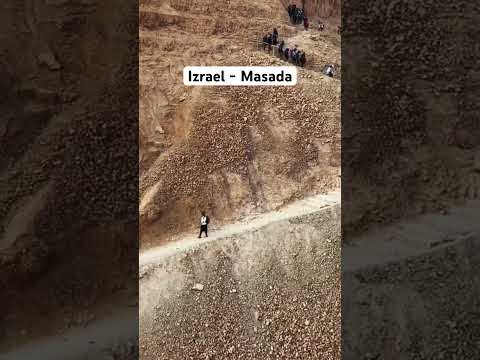
Israel is not just about biblical stories, but also a unique site overlooking the Dead Sea. That place is Masada.
The Middle East is packed with stories and monuments, and every country here has something to offer. Israel is not just about biblical stories, but also a unique site overlooking the Dead Sea that draws people from all over the world. That place is Masada, and it invites you to visit.
Masada Fortress, steeped in stories and legends, stands in central Israel. All around stretches a landscape of sandy shades, with browns and darker colours blending into a single, shapeless impression. Small hills rise out of a kind of semi-desert, coming to a halt at the shore of a unique body of water. Right here, within reach of historic Masada, lies the edge of the Dead Sea. The ruins of the fortress have seen everything. They watched the Romans pass through, civilisations change, faces and centuries come and go, and the Dead Sea shrink before their eyes. Today, its shores lie metres, even tens of metres away from where they once were, and Masada remembers it all. If the fortress stretched out a hand, it might even reach neighbouring Jordan, as the border between the two countries lies less than five kilometres away as the crow flies. An intriguing location, far from civilisation and almost 100 kilometres from Jerusalem, yet everyone who finds themselves in the Holy Land longs to visit. Why is that? Because of the story it holds!
You will notice Masada long before you stop at its foot. In the distance, a hill resembling a table mountain emerges, unlike anything else around it, so you know something unique awaits. Crowned by the fortress ruins, the hill rises more than 400 metres! One look at it and you cannot imagine how anyone could even contemplate conquering it. Conquering it? How did anyone even decide to build their palaces right up there on the summit? It must have taken an enormous fear of the world below to make someone want to shut themselves away on top of a deserted mountain. If you want to reach the top of Masada today, you have two options. You can take a comfortable ride in a modern cable car and be up in a few minutes, or, if you have plenty of time and are very fit, you can walk up the so-called “Snake Path”. It really does wind up the hill like an enormous snake, and those who choose it will cover around six kilometres on foot. The climb usually takes two and a half hours, but if you stop to take photographs, which you certainly will, and rest, which you certainly will too, allow a good three hours for the ascent. The result will be worth it. You will find yourself on the threshold of the legendary Masada Fortress.

Deserted and remote, Masada is a place people have visited since time immemorial. Although we associate its story mainly with Roman times, and thus the 1st century, people knew Masada long before that. The earliest traces of humans date back several millennia: grains of barley were found in a small cave called Yoram, telling us that something was happening here 6000 years ago. We do not know whether people stayed for a long or a short time, but this points to an important historical trace in the region. For several centuries, Masada seems to have slipped from people's minds, before resurfacing in history in the 1st century BC, when a ruler named Alexander Jannaeus is said to have decided to fortify it. Today, we have almost nothing tangible from his time, but the historian Josephus Flavius, who later became something of the father of Masada's story, mentions him. Masada's great history begins when Herod the Great takes possession of the fortress in the 1st century BC, after the death of his father Antipater. Between 37 and 31 BC, Herod decides to build lavish, luxurious palaces far from Jerusalem, where he can retreat in the event of danger. Masada's history thus began to change forever.
Just a few steps from the cable car take you beyond an imaginary rampart, where a view of Masada's interior opens up. Several stone watchtowers rise from the walls, and one of the first things you see is an enormous pit that served as a quarry. Masada's builders therefore did not have to laboriously haul all the stone from the bottom to the top, but quarried it right beside the places where they would later build their magnificent palaces. A little further on, the first residence appears, and here you already realise that you have arrived somewhere extraordinary. Traces of colourful frescoes decorating the walls are still visible. Sooner or later, you will also notice a prominent black line running across almost all of Masada's buildings, their façades and walls. Everything above it has been reconstructed, while everything below it is original and has survived here for centuries. Many parts were reconstructed precisely to give visitors a better idea of what these places might have looked like and to fire their imagination. Beyond the elongated rooms used as storerooms appear the ruins of lavish baths. The Romans loved them, and the Arabs later adopted the concept, which was perfected by the Ottomans, thanks to whom they are found everywhere from the Balkans to North Africa. These baths, too, were commissioned by King Herod. First, you can enjoy looking at the model, and then step inside among the ruins. You can still clearly distinguish the rooms that formed the core of the baths: those for cold, lukewarm and hot water. The last of these, called the caldarium, even had “underfloor heating” and walls lined with hollow bricks through which hot air circulated. Every detail, no matter how small, was considered here
1 / 3