Less than thirty minutes from the bustling streets of Hanoi lies a village where the potter's wheel has kept turning for seven hundred years. In Bat Trang, you will not only watch local artisans transform ordinary red clay into traditional Vietnamese pottery – you will also try shaping it with your own hands. Read on to discover why this seemingly unassuming stop is one of the most authentic experiences northern Vietnam has to offer.
Imagine a lane filled with fired pots stacked up to the rooftops, air scented with clay and smoke from the kilns, and an old man who, without a word, sets a potter's wheel spinning with just a movement of his fingers, exactly as his ancestors did seven hundred years ago. This is not a museum reconstruction. This is an ordinary morning in the village of Bat Trang, less than half an hour's drive from the bustling streets of Hanoi. If you are heading to northern Vietnam, this is where one of the most authentic experiences of your entire trip awaits – which is exactly why we have chosen it as the subject of today's article.
Bat Trang lies on the banks of the Red River (Song Hong), the same river that has shaped not only the landscape around Hanoi for centuries, but also, quite literally, the local craft. Its deposits brought exactly the kind of clay potters needed – fine, pliable and ideal for both throwing and firing. Today, the village is administratively known as Bat Trang Commune and is part of the wider Hanoi area, yet its atmosphere feels like an entirely different world: narrow lanes lined with pottery shards embedded directly into walls, small shops filled with thousands of pieces of tableware, and air that seems thick with centuries of work. The name Bat Trang can be loosely translated as “the place of bowls” – and a walk through the village will show you just how fitting it is.
According to available sources, the history of pottery in Bat Trang dates back to the 14th–15th centuries. Some family records even suggest that the craft was developing in the area as early as the time when King Ly Cong Uan moved the capital to Thang Long, present-day Hanoi. With excellent clay right beneath their feet and a favourable riverside location that provided a natural trade route, the village gradually became one of northern Vietnam's most important centres of craftsmanship.
By the 17th century, pottery from here was being exported as far as Japan and China, as well as to European traders – Vietnamese porcelain and stoneware sailed out into a world that knew little about Vietnam but had grown fond of its ceramics. Later, at the beginning of the 20th century, restrictive measures introduced by the Nguyen dynasty affected the craft, and production declined for a time. A true revival came only after the economic reforms of 1986, known as the Doi Moi policy, when Bat Trang found a new lease of life. Today, its products are once again exported around the world.
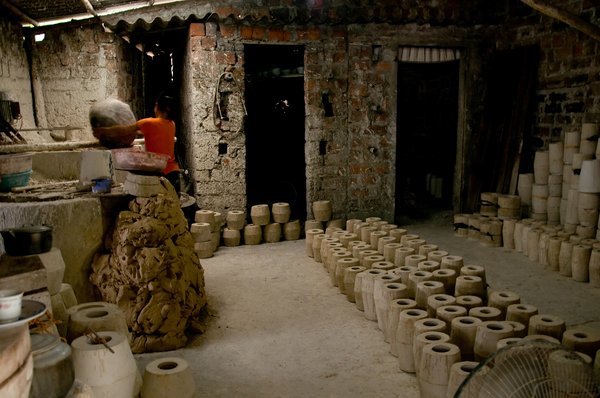
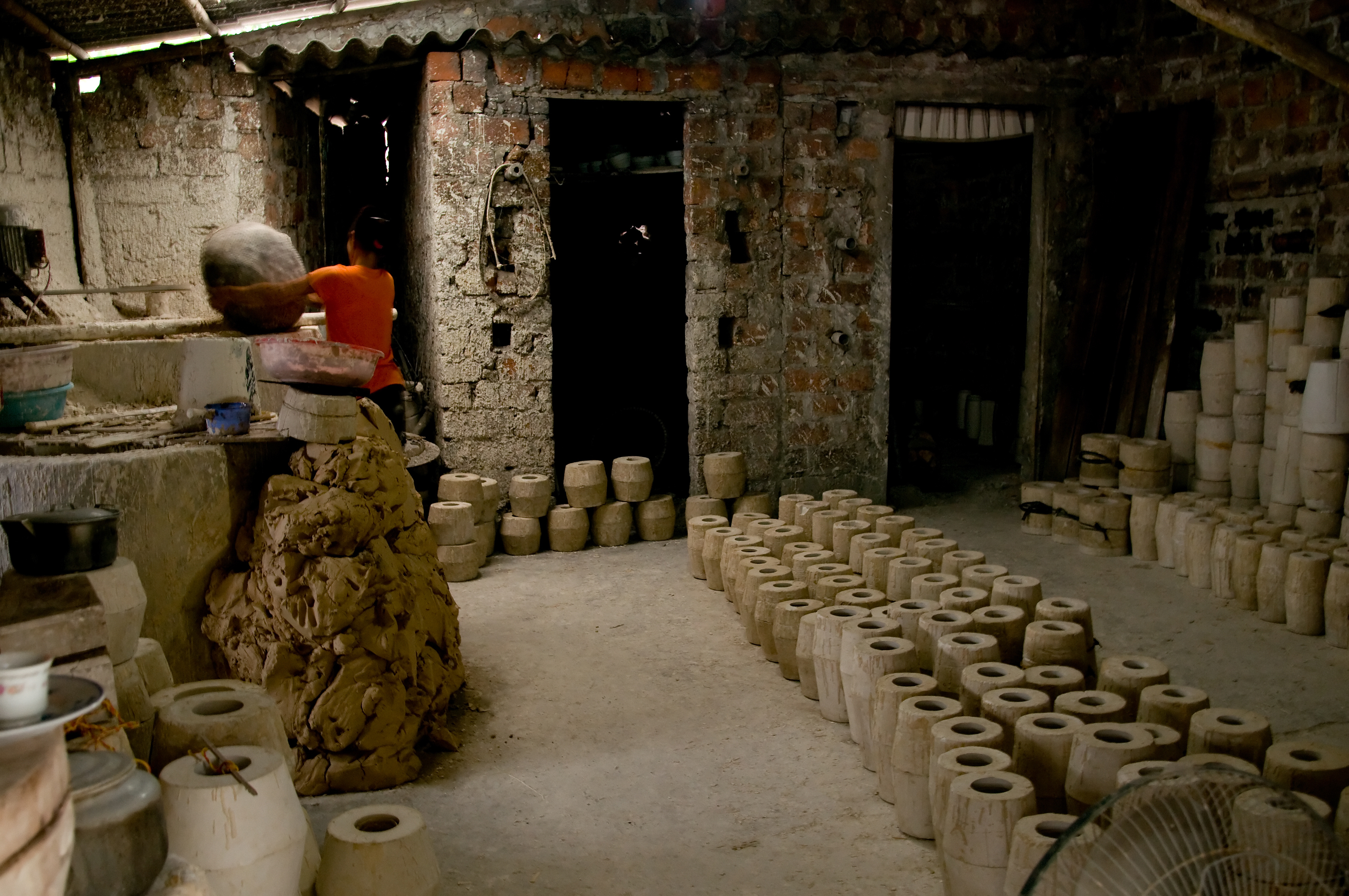
The craft you will see in action here follows precise methods refined over centuries. Yellow clay forms the body of the pieces, while white clay is used to prepare glazes – mixed with ash from the kilns or from mangrove wood to create characteristic shades of white, red or yellow glaze. It is this combination of local raw materials and techniques perfected over generations that gives Bat Trang pottery its distinctive character: slightly earthy yet delicate.
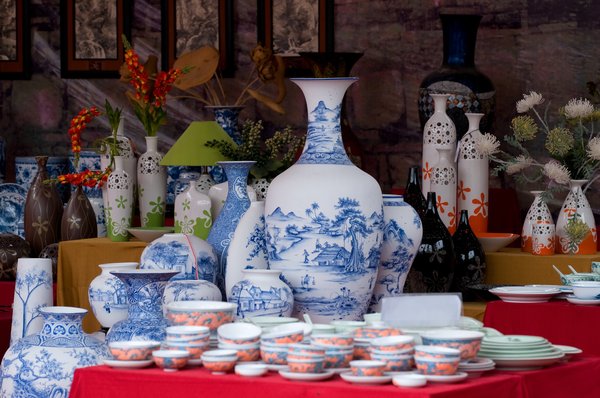
Among the best-known traditional products is the “bat dan” – a simple, durable white bowl with a wide rim, once used in almost every Vietnamese household. Today, alongside it, you will find tea sets, vases, decorative pieces and religious objects that bring traditional craftsmanship together with contemporary design.
At the heart of the village is a pottery market covering approximately 6,000 square metres – a maze of stalls where inexpensive, simple bowls stand alongside intricately painted vases that would not look out of place in a gallery. The village also has a pottery museum with an unusual design comprising seven funnel-shaped buildings inspired by the shape of a potter's wheel. Inside are rare historic pieces documenting the development of the craft from its beginnings to the present day.
What makes Bat Trang truly unforgettable is not just watching the masters at work – it is the chance to try throwing clay yourself. You sit down at a potter's wheel, your hands turn red with clay, and, under the guidance of an experienced artisan, you create your own piece of Vietnamese pottery: imperfect, but all the more precious for it. This is exactly what independent travel is about – not just looking, but trying, getting your hands dirty and bringing home something you have made yourself. Here at Travego Tour, this is also one of the stops our travellers ask about most often after returning home.
After hours spent among clay and kilns, it is worth sitting down in one of the local restaurants to try the traditional squid and bamboo shoot soup – a simple yet hearty dish that has been served here for generations. It is exactly the kind of experience you bring home from Vietnam not in a photograph, but in your memory of its flavours.
Bat Trang is proof that the most powerful travel experiences are often found not behind a ticket to a magnificent monument, but in a quiet lane where a centuries-old tradition is still turning – quite literally – before your eyes. And you can see and experience this very place, along with other parts of magical Vietnam, on a tour with Travego Tour.
1 / 2