As darkness falls in India, small oil lamps are lit outside homes, colourful patterns appear on doorsteps, and families gather around the festive table. But Diwali is much more than a beautiful display of lights. It is a festival steeped in ancient legends, symbols and traditions that vary across India. Why do Indians light lamps, whom do they welcome with them, and what exactly are they celebrating?
Imagine an evening in India after dark. Small clay lamps burn outside homes, entrances are decorated with patterns made from coloured powders and flowers, conversations drift from inside, and plates piled with sweets await on the tables. This is no ordinary evening. India is celebrating Diwali – one of its most important and best-loved festivals.
The festival takes its name from the Sanskrit word Deepavali, meaning a row of lit lamps. Light is its most important symbol. Yet behind its beautiful atmosphere lies much more than decoration. Diwali brings together ancient legends, family rituals, celebrations of prosperity and the belief that good will ultimately triumph over evil.
One of the best-known legends associated with Diwali comes from the ancient Indian epic Ramayana. It tells the story of Prince Rama, who had to leave his kingdom and spend fourteen years in exile. He was accompanied by his wife Sita and his brother Lakshmana.
During their exile, Sita was abducted by the demon king Ravana. Rama set out to rescue her and defeated Ravana after a great battle. When Rama finally returned to Ayodhya, tradition has it that the city's inhabitants welcomed him with thousands of lit oil lamps. The lights celebrated the return of the rightful ruler and the victory of good over evil.
This is the story most closely associated with Diwali in northern India. Here, light represents more than a hero's victory over an enemy. It also symbolises hope, order and the return of peace after a period of uncertainty.
Diwali is also inseparably linked with the Hindu goddess Lakshmi, a symbol of prosperity, abundance, good fortune and well-being. According to tradition, she visits people's homes during the festival and brings them blessings. Many families therefore clean their homes thoroughly before Diwali, decorate them and prepare for her symbolic arrival.
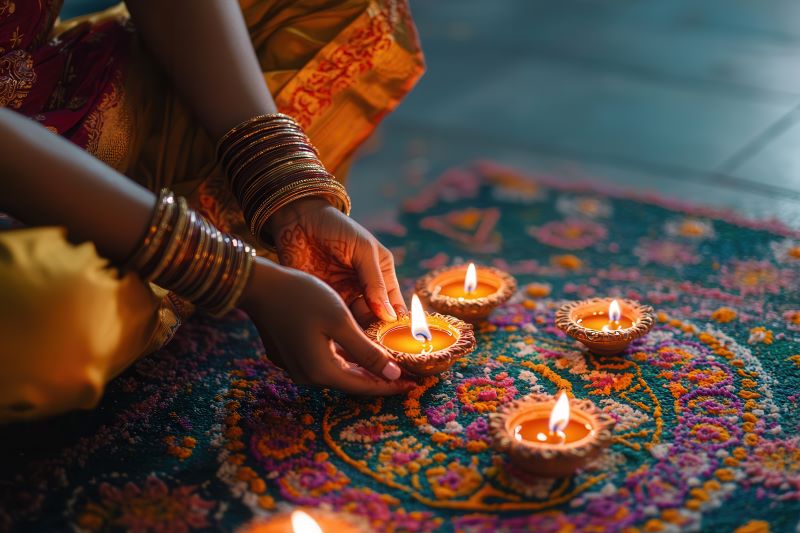
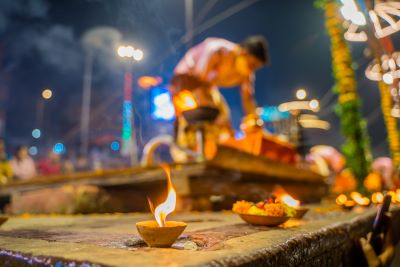
They light small oil lamps called diyas outside their doors, on windowsills and on steps. Their light is intended to guide the goddess into the home. Many families also perform Lakshmi Puja – a ceremonial prayer asking for prosperity, health and an auspicious new beginning.
In this understanding, however, wealth means more than money. It also encompasses family harmony, having enough, inner peace and success in everyday life.
One of the most beautiful Diwali customs is creating rangoli. These are colourful patterns on the ground, usually outside the entrance to a home or in an inner courtyard. Made from coloured powders, rice, sand or flower petals, they can take the form of flowers, geometric designs or intricate ornaments.
Rangoli are more than decorations. In many families, they symbolise hospitality, good fortune and an invitation for positive energy to enter the home. Creating them is often a shared family activity, with the tradition passed down from generation to generation.
Southern India has related traditions known as kolam, in which delicate patterns are created using materials such as rice flour. What visitors see as beautiful decoration is, in fact, part of a rich cultural heritage.
Diwali is often described as a five-day festival, although the exact sequence of events can vary between regions. Celebrations begin with preparing homes, shopping and decorating. One of the first days, Dhanteras, is associated with prosperity and the tradition of buying metal objects, particularly gold or silver.
The celebrations reach their peak on the evening when families pray together, light lamps, visit relatives and exchange gifts. Tables are laden with traditional sweets, collectively known as mithai. These include treats such as laddoo, barfi and jalebi.
In some communities, Diwali also marks the symbolic start of a new business year. Traders open new account books and pray for success in business.
Although Diwali is outwardly associated with spectacular lights and a festive atmosphere, for many people its most important aspect is the time spent with family.
India is a country of immense cultural and religious diversity. Diwali therefore has no single story. In the north, it is closely linked to Prince Rama's return to Ayodhya. In southern India, the festival is also associated with the god Krishna's victory over the demon Narakasura. Celebrations there may begin early in the morning with an oil bath, dressing in new clothes and sharing a meal.
In West Bengal, this period is strongly associated with worship of the goddess Kali. For Jains, Diwali commemorates the spiritual liberation of Mahavira. Around the same time, Sikhs observe Bandi Chhor Divas, a festival associated with the release of the sixth Sikh guru.
Different legends, different customs, different regional expressions — yet a similar message. Diwali is a festival of hope, light, new beginnings and the belief that goodness matters.
Diwali in India's major cities today looks different from the celebrations of centuries past. Cities glow with electric decorations, shops prepare festive window displays, and many people travel hundreds of kilometres to spend the festival with their families. Fireworks are also traditionally associated with the celebrations, although their effects on air quality, noise levels and safety are increasingly debated, particularly in large cities.
Alongside modern celebrations, there is therefore growing interest in more traditional, quieter and more environmentally friendly ways of celebrating Diwali. Yet its essence remains unchanged. Whether in a modern apartment in Mumbai, in southern India or in the home of an Indian family living abroad, the small flame of an oil lamp remains a powerful symbol of hope and continuity.
Diwali is more than a beautiful festival with a visually striking atmosphere. It is a living tradition that connects generations, strengthens family and community ties, and preserves an important part of India's cultural identity.
The traditions of making lamps, festive dishes and decorative patterns, along with family rituals, are passed down within households and communities. This is another reason why Diwali deserves attention not only as a festival that attracts visitors, but also as a profound cultural phenomenon.
Diwali has no fixed date in our calendar. Its timing is based on the Hindu lunisolar calendar, so it falls on a different day in October or November each year.
This is one of the reasons its exact date changes every year. The essence of the festival, however, remains the same: even after a period of darkness, light can return.
India's distinctive character lies not only in its monuments, palaces, temples and bustling streets. Its true wealth is also found in the traditions, rituals, festivals and everyday lives of its people.
On our sightseeing tour India – A Uniquely Colourful Country, we also discover India through its culture, history and the atmosphere of places such as Mumbai, Aurangabad, Chennai, Mahabalipuram, Pondicherry, Thanjavur, Trichy, Thekkady and Cochin. Journeys like these are not just about what we see, but also about what we come to understand more deeply.
Festivals such as Diwali show that India is more than a destination. It is a world of symbols, colours, family traditions and stories that live on.
Explore India with TRAVEGO and discover a country you can only truly understand when you look deeper.
1 / 2