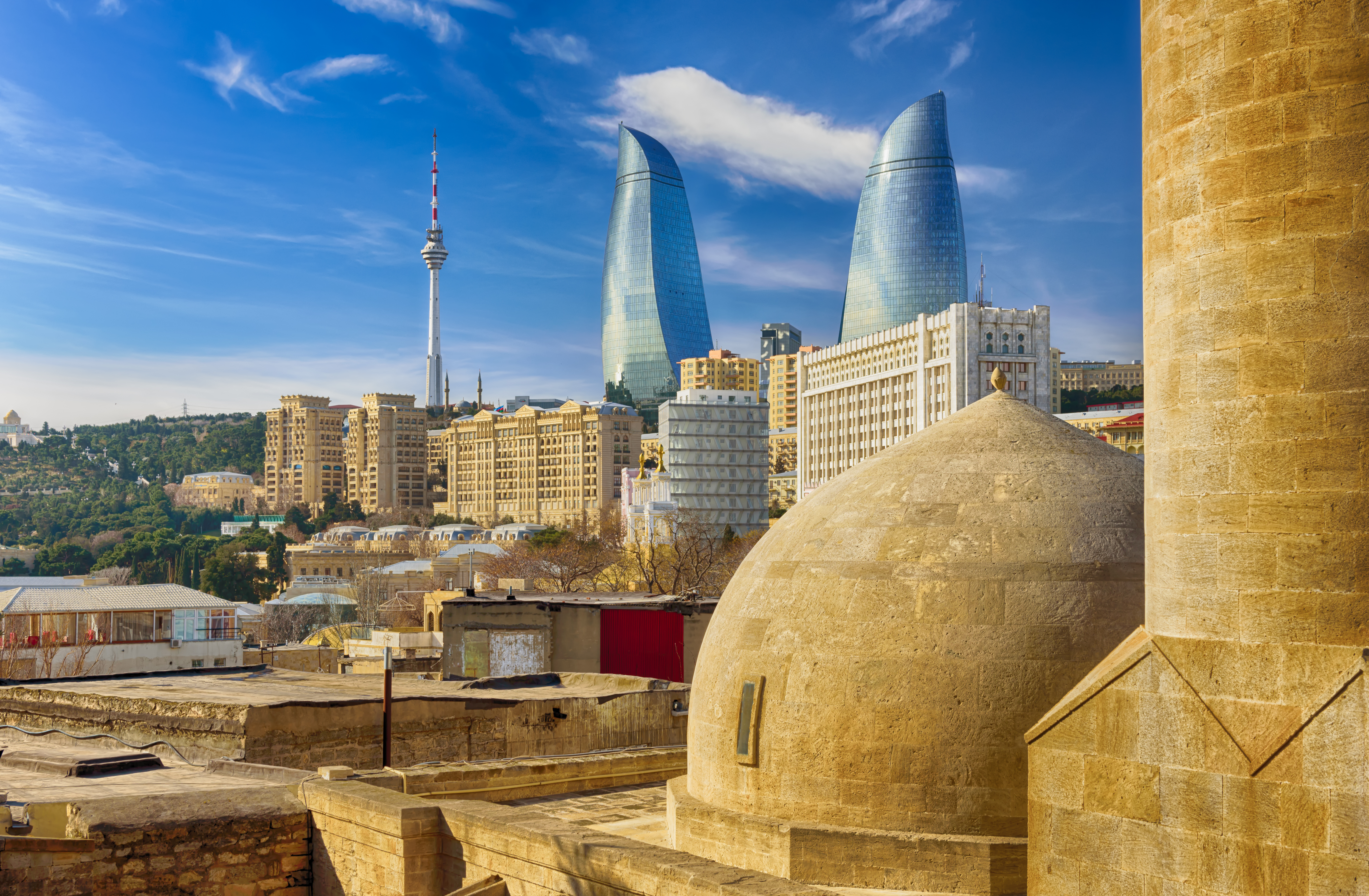
Azerbaijan, nestled in the Caucasus, holds a wealth of beauty. Some are drawn by its snow-capped mountains, others by the exotic appeal of the Caspian Sea, the Eastern charm of Sheki's hidden corners or the modernity of Baku. Yet Azerbaijan also has one enormous attraction that will rank among your greatest experiences in the country. Have you heard of mud volcanoes?
Mud volcanoes are one of Azerbaijan's distinctive features. Not because you cannot find them in other countries, but because more than half of the world's mud volcanoes are located right here, in this country beneath the Caucasus. Azerbaijan is said to have around 400 of them, while the worldwide total is probably somewhere around 700. Quite something, isn't it? So, if you are thinking of visiting this exotic country, keep in mind that a visit to the mud volcanoes is something you must not miss. You will find most of them around the capital, Baku. Nearby stretches the Absheron Peninsula, known for its oil, and not far from it lies Gobustan, dotted with small muddy hills that attract adventurers from all over the world. The Shirvan Plain is no less impressive, but wherever you go, you will discover a rarity that you will remember fondly back home.
The journey from Baku to Gobustan, south of the capital, does not take long. An hour, and you are there. The Eastern city of Baku hidden behind its walls and the modern buildings reaching for the sky disappear, and beyond a hill, a plain opens up. This is where Gobustan lies. Oil was discovered in the area long ago, and the oil rigs hovering above the waves of the Caspian Sea reveal that it is not confined to dry land. All that remains is to pass the exceptionally precious petroglyphs, which have even earned a place on the prestigious UNESCO list, and you find yourself somewhere with a landscape reminiscent of another planet. That is the feeling the mud volcanoes give you, because you have never seen anything like them before. Mud volcanoes are smaller, low hills and mounds, though some are larger hills. The surrounding lunar landscape is quiet, but if you listen closely, you will hear gentle bubbling and popping whenever a bubble forms in a volcano and suddenly disappears. You take a few photographs and finally approach with due respect to come face to face with a mud volcano. It is an adventure to be in such a place, so close to a spectacle of nature. The small craters compete to attract your attention, and every so often one of them “pops” a little more vigorously, splashing grey droplets of mud. Some volcanoes spit out so much that it spills over and flows down onto the broad plain, while others keep it to themselves. A little later, you dare to dip a finger or your whole hand into a mud volcano. It will not be hot; no scorching mud will burn you. Quite the opposite. The volcanoes are pleasantly cool, and they even have many beneficial effects on the skin, so you will often see locals coating their hands with mud. You have to try it, because this is exactly the kind of experience that nobody back home will want to believe.
Most mud volcanoes are not enormous, so it may seem that all they do is form small bubbles that burst, but many can spring quite a surprise. Some volcanoes have erupted violently enough in the past to cause problems. Observations of the volcanoes have been recorded since the early 19th century, revealing that some have erupted more than 200 times, while others have erupted only a few dozen times, but more powerfully. One of the most powerful volcanoes in all of Azerbaijan is the Ayranteken mud volcano, located approximately 65 kilometres from Baku. It is even known for its underground eruptions. It rises to 190 metres, and we may yet hear more about it, because an 800-metre fault lies nearby. During an eruption, the Moose volcano even blasted its contents almost a kilometre into the air and caused an earthquake. Among the most recent notable eruptions is that of Dashli Ada, whose eruption in 2021 lasted a full eight minutes. It sent material half a kilometre into the air and frightened many people. When you stand at a smaller mud volcano site, the peace radiating from the landscape could never convince you that the volcanoes can sometimes cause serious trouble for the surrounding area and nearby residents.
Mud volcanoes are a fascinating phenomenon. Over the years, scientists have discovered that their mud contains as many as almost 100 different minerals and almost 30 chemical trace elements, including barite, mercury, manganese, copper, barium, strontium and even lithium. Everything flowing out of the volcanoes, from mud to lava, is even used in the chemical, construction and pharmaceutical industries. Many of the minerals contained in volcanic mud are also used in cement production. Before the volcanoes came under national park protection, people used to steal the mud to help with cement for their building projects at home. Even more interesting is the fact that volcanic mud helps treat skin diseases, rheumatism and even conditions associated with the nervous system. People even believe that the mud is so healing that it can help regenerate skin affected by scarring. During the Soviet era, the mud was also used to make plaster casts for broken limbs. Not every volcano can help, however, as some may even contain traces of radioactivity. There is no need to fear them, though, because scientists monitor them thoroughly and keep them under observation.
If we traced the origins of these volcanoes, we would come across hydrocarbon deposits, and they are also very closely linked to oil and oilfields. Several oil deposits were discovered near mud volcanoes, and among the best-known volcanoes are Lock-Batan, Neft Dashlary and Garadagh. Pinpointing exactly when mud volcanoes began appearing in Azerbaijan is almost impossible today, but according to many researchers, it happened sometime around 25 million years ago. Over that time, they have quite literally become part of the landscape, so it is no wonder they have become symbols of Azerbaijan.
Did you know that, in addition to mud volcanoes on land, Azerbaijan also has unique underwater mud volcanoes? In the oil-rich Caspian Sea, we could count almost 140 mud volcanoes, and eight smaller islands around Baku are even considered to be mud formations created by stronger eruptions millions of years ago. The volcanoes were active beneath the sea's surface, making their activity invisible to the world, but scientists have established that they too are several million years old and have identified many underwater eruptions from their deposits. All the same, it is better to head onto dry land and explore the beautiful and exceptionally interesting landscape dotted with mud volcanoes. This will be one of your greatest experiences in all of Azerbaijan.