The South Caucasus is above all about beautiful scenery, dramatic peaks, tiny villages at the ends of the earth, hospitable people and wonderful food. You might think cities have no place here, but then you arrive in Georgia's Tbilisi and it steals your heart. No wonder: Tbilisi reshuffles the deck, and you realise it is the most beautiful city in the entire Caucasus. Don't believe us? Come and explore its old streets with us!
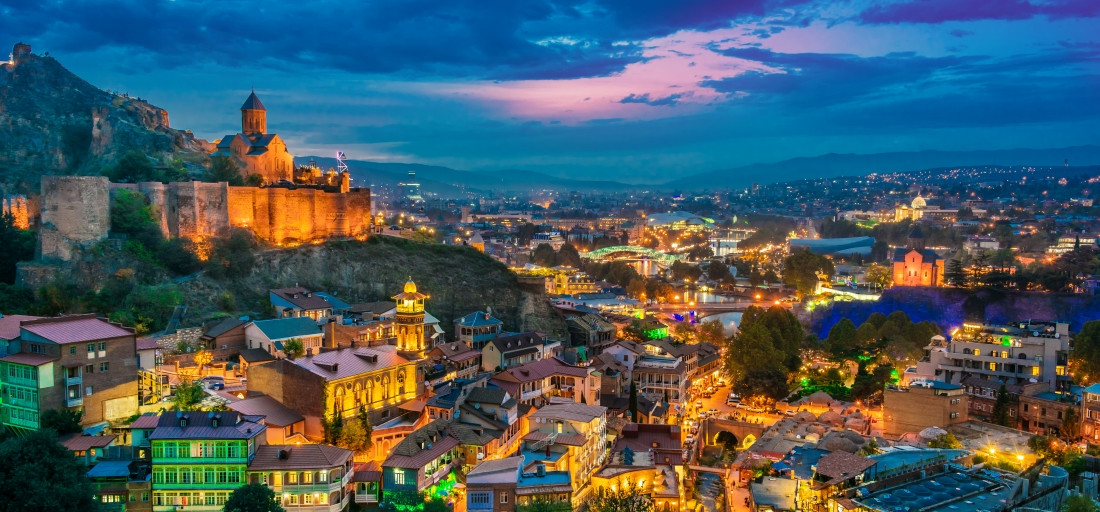
Many people have heard of Georgia's capital, Tbilisi, yet cannot picture anything that captures its character. That is, until they find themselves in its old lanes, beneath church towers and hills, surrounded by an atmosphere so captivating that you will always have to leave sooner than you would like. Tbilisi has an indescribable magnetism. Once it switches it on, you are bound to it forever. The old town breathes the air of a forgotten Orient. Its narrow streets are lined with age-old houses with colourful mosaic windows, and here and there locals sit chatting. Among the houses, a small church, a bell tower or a house resembling a palace appears where nobody would expect one. The streets of old Tbilisi suddenly spill out into a square beneath the enormous Narikala Fortress. Tbilisi has several symbols, and this fortress is one of them. It sits high on a hill, reigning like a royal crown and watching over the city's peace. A stylish cable car leads up from the opposite bank of the Mtkvari River, or you can climb a few flights of steps and touch its stone ramparts. Narikala is said to be as old as the city itself, and it has become an inseparable part of it. It was known to the Persians and Arabs, and several centuries later to the Russians, who released the tsar's eagle here, spreading its “protective” wings over the entire Caucasus. Today, the little Church of St Nicholas stands up behind the walls, but people come here for the peace and the views. This is where you will find Tbilisi's finest panorama. The whole city spreads out at your feet. The old quarter stands on one bank, and the newer part, adorned with the enormous Tsminda Sameba Cathedral, on the other bank of the Mtkvari. It is beautiful here in the morning, but the fortress and its views have a special charm in the early evening too, when darkness begins to settle over the city. The city resists, switching on its lights as if to show that it never sleeps.
The neighbourhoods below the fortress are steeped in history. As you walk downhill to reach the banks of the fast-flowing river again, an old mosque with a minaret appears along your route, and eventually, behind the façades of the houses, you discover a district called Abanotubani. It is intertwined with the legend of the city's founding, which tells of Vakhtang Gorgasali, now the legendary father of Tbilisi. Centuries ago, he is said to have hunted pheasants or wild birds nearby and discovered sulphur springs, where he decided to settle. The façade of the Oriental baths resembles the madrasas of the Silk Road, and these are not the only baths you will find here today. Several similar places grace the neighbourhood, and the traditional baths are an enormous attraction. Not just today, either: among the most famous guests to immerse themselves in the sulphurous waters were Alexander Pushkin and the French writer Dumas. Will you be tempted too? You can hire an entire room here and enjoy a little taste of Georgia. Once you have had your fill of the baths, just a few steps bring you to the riverbank, with the beautiful little Metekhi Church rising on the opposite side. It stands above the river on a dramatic rocky cliff, which has helped secure its place among the capital's icons. Right beside it, a statue of the city's founder occupies a prominent position. From his horse, he gazes at the city into which he breathed life. Even he probably never imagined, though he surely hoped, that Tbilisi would become one of the most beautiful cities in the entire Caucasus.
The old town's lanes are appealing not only for their atmosphere but also for their wonderful little establishments, wine bars and restaurants. Georgia is one of the world's most delicious destinations, and Tbilisi is a city for gourmets. Simply take a seat in one of its welcoming establishments, and a difficult task awaits. Not because you cannot find anything to choose, but because everything is so delicious that you will want to taste every single dish, one after another. Choose traditional khachapuri filled with salty cheese, though, and treat yourself to a few sips of excellent local wine from Kakheti. Georgians love their wine, are rightly proud of it and will declare without hesitation that it originated right here in their country. Georgian cognac is well worth trying too, and sooner or later you are sure to get around to it. The harmonious blend that gives old Tbilisi its character is beautifully unique. All you need to do is walk through its lanes, and something remarkable appears before your eyes at every turn. One moment it is a little Armenian church, a little further on an old synagogue, a church with Orthodox crosses and iconostases, or grand houses that seem to have succumbed to the ravages of time and are slowly disappearing before your eyes. Several peoples lived here side by side as friends and called this place home, but those times have faded away. Although Tbilisi remains a tolerant place, many were swallowed up by the historical events of the centuries. People sit on the benches outside Sioni Cathedral, trying to escape the bustle of the street. The first cathedral appeared on this site as early as the turn of the 6th and 7th centuries, but since then it has crumbled to dust and risen again so many times that nobody can count them. The façade is several centuries old, yet it looks as though its paint has only just dried. Its real importance, however, lies in the cross it holds within: that of St Nino, who brought Christianity to the country.
Freedom Square in the city centre is now watched over by a golden statue of St George fighting the dragon. Georgians regard him as their patron saint, and it is wonderful to see him atop the tall column, because Lenin once gazed out over the city from this very spot. As socialist symbols fell and the “immortal” empire crumbled, Georgians found themselves in a civil war. Although you will not notice it on the streets today, it still lives in the souls of those who remember it. The city's main boulevard is modern, smart and well maintained, lined with good hotels, cafés and boutiques. Here you will also find the famous Kashveti Church, the Church of the Birth of a Stone, with its hidden legend of a monk whom a nun accused of fathering her unborn child. He replied that if it were not true, she would give birth to a stone, and so Kashveti, the “stone church”, still stands here today. Locals walk past it, and many stop for a few seconds to cross themselves three times. If you would like to go inside, feel free to enter: you will be enchanted by an atmosphere filled with the scent of candles and their tiny flames flickering beneath age-old frescoes. From here, it is not far to the district of Marjanishvili. It brims with life and markets, and if an awning were stretched over them, you could easily believe you were in the Orient. Calls ring out, sellers praise their goods, vendors and passers-by converse loudly: life that you cannot hold in your hands, yet that is everywhere you look. It is an exceptionally pleasant place, and once you get used to the initial rush of chaos, you will enjoy being here. The aromas of little bakeries selling fresh bread and khachapuri drift out into the street, and here and there one or two tables appear, serving coffee or a glass of beer. A flea market awaits around the corner, while the next street offers fruit and vegetables and, in autumn, kilos upon kilos of fantastic grapes.
The Mtkvari riverfront has changed greatly in recent years. It used to be neglected and held little appeal, but today you will find several points of interest here. Everyone notices the modern bridge connecting old Tbilisi with the newer neighbourhoods. It is 150 metres long and so modern that at first glance it seems somehow out of place. A modern Presidential Palace has risen above the neighbourhood, and a cable car now runs from the riverfront up above the city to the feet of the enormous Kartlis Deda statue. Georgians call her the “Mother of Georgia”, and she stands an impressive 20 metres tall. In one hand she holds a sword, and in the other a bowl of wine. You simply have to choose which is closer to your intentions. Those who come with ill intent will taste the sword's edge; those who come in friendship will be showered with litres of wine. Another symbol of today's Tbilisi is the immense Tsminda Sameba Cathedral, whose name translates as the Cathedral of the Holy Trinity. It is one of Tbilisi's newest places of worship, and its size quickly secured its place, gracing the skyline of the entire district. As you walk towards the cathedral, its golden tip, reaching a height of 80 metres, grows larger with every step. It truly is an enormous complex. You feel very small within it, yet it lacks the soul of the age-old churches in the city centre. Everything here is huge, vast and imposing, as though intended to knock you off your feet. Its interior is a space of utter emptiness, filled with an altar and other details that disappear into the vastness. Even so, it is an interesting place, because it has become part of Tbilisi.
Even if you have explored old Tbilisi from end to end, return and look for beauty you may not have noticed at first glance. The longer you stay in Tbilisi, the more this place reveals. Say hello to the little statue of the Tamada, ready to raise a toast, glance at the men playing board games in the park, and finally let yourself be tempted by the sweet scent of traditional Georgian treats. Churchkhela will catch your eye immediately. It resembles little sausages threaded onto strings, hanging in shops or markets, but do not expect to find any meat inside. Churchkhela is a traditional sweet made mainly of nuts coated in grape juice with a jelly-like consistency. Taste it once, and you will immediately return to buy some to take home. It will be the best Georgian gift! In the early evening, head for Lesilidris Street and settle into one of its bars. Over a glass of Georgian cognac, all your experiences of Tbilisi will sink in! There will be plenty of them, to say the least.